

History
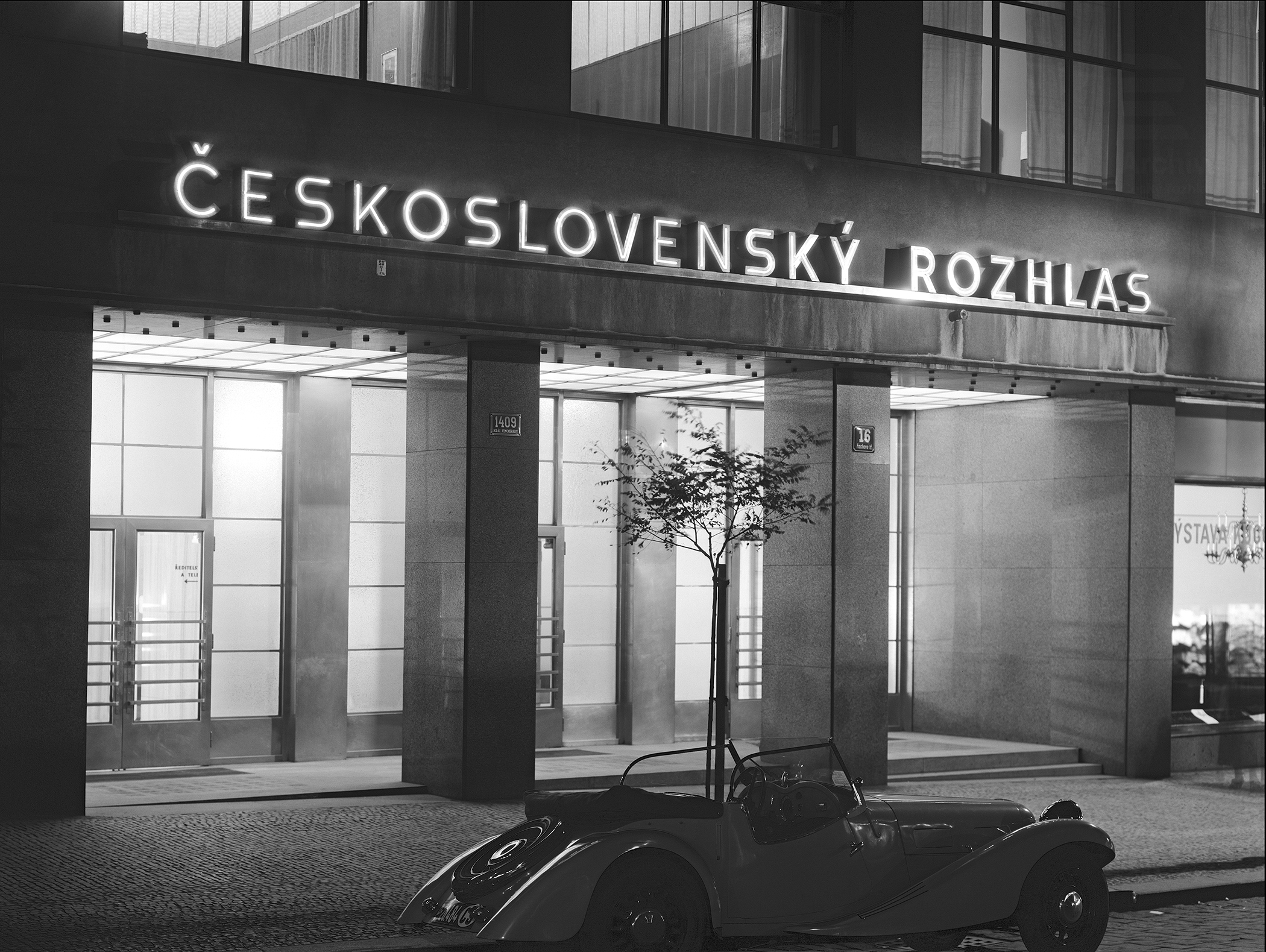
The history of Czech Radio began with the launch of regular radio broadcasting in Czechoslovakia on 18 May 1923, when the station Radiojournal transmitted from an improvised tent in Prague’s Kbely district. This made Czechoslovakia the first country in continental Europe to launch regular radio broadcasting, mere months after the BBC started its own service in the United Kingdom.
What began as a technically modest project gradually developed into an established fixture of the country’s public and media life.
In the years that followed, broadcasting extended beyond Prague, with a regional studio opening in Brno in 1924, followed later by studios in Bratislava and Ostrava. As radio developed, the need for a permanent and purpose-built headquarters became clear. That need was met in 1933, when a new broadcasting building in Prague’s Vinohrady district, at today’s Vinohradská 12, was officially opened.
Before WWII, radio had already become an important source of news, information and cultural programming. In 1936, Radio Prague began broadcasting to audiences abroad, laying the foundations for Czech Radio’s international service. From that point on, the station addressed both domestic listeners and foreign audiences interested in developments in Czechoslovakia.
A major chapter in the history of Czech Radio came in May 1945, during the Prague Uprising. It was Czech Radio broadcasts that helped set the uprising in motion, with on-air calls encouraging resistance against the Nazi occupation. Events surrounding its headquarters, known as the Battle for Czech Radio, became one of the defining moments of the Prague Uprising. Many of those defending the building lost their lives, and the events of May 1945 remain an enduring part of the institution’s history.
The post-war decades reflected the wider political development of Czechoslovakia. After the 1948 Communist takeover, radio operated under a system built on censorship and state control. Even under these conditions, it remained a key medium of public communication. Another turning point came in 1968, during the Prague Spring and subsequent Warsaw Pact invasion, when Czechoslovak Radio provided information at a time of political uncertainty and military intervention. Fighting around the station’s main building again claimed lives and confirmed the importance of radio at a moment of national crisis.
The political changes of 1989 paved the way for a redefinition of the institution’s role. With the end of Communist rule, radio moved away from a state-controlled model and toward public service broadcasting. This transition was formalised in the early 1990s, when new legislation established Czech Radio as an independent public service institution.
Today, Czech Radio is a public service media institution providing nationwide, regional and international broadcasting. Its output includes news, current affairs, spoken-word programming, literature, drama and other original content distributed via radio broadcasting, digital services and online platforms including iROZHLAS and mujRozhlas.